Word Search Kids Activity for KDP Vol-30
There is something quietly satisfying about watching a child lean over a grid of letters, pencil in hand, eyes scanning for a hidden word. It is a small moment of focus that feels increasingly rare in a world of endless notifications and instant entertainment. Word search puzzles have been a staple of kids' activity books for decades, and for good reason. They are simple to explain, require no special equipment, and deliver a genuine sense of accomplishment when the last word is circled. Word Search Kids Activity for KDP Vol-30 brings this classic format into a well-organized, thoughtfully designed package that feels both familiar and fresh.
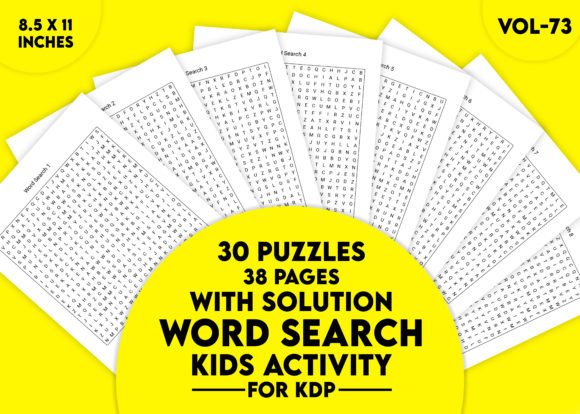
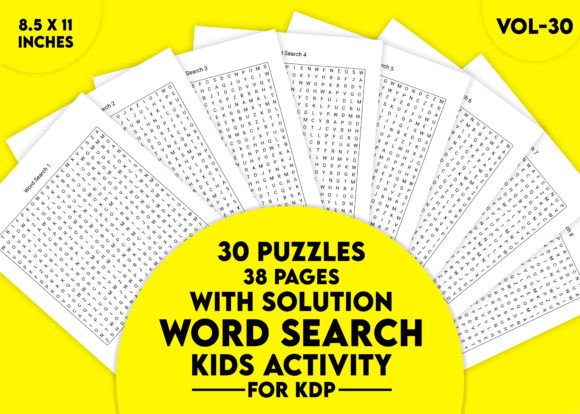
At its core, this collection offers 30 individual word search puzzles, each presented on its own page. The grid size, letter spacing, and overall layout have been designed with young readers in mind. The puzzles are printed in an 8.5 x 11-inch format, which means the letters are large enough to read without straining, and there is plenty of room around the edges for little fingers to hold the page steady. Each puzzle comes with a theme, and those themes vary widely enough to keep a curious child engaged from the first page to the last. Animals, seasons, holidays, food, sports, and everyday objects all make appearances. The variety is not random—it feels intentional, as though someone took the time to think about what actually captures a child's attention.
One of the standout practical features of this volume is that solutions are included. Every puzzle has an answer key, and those solutions are arranged four per page. This is a small detail that makes a big difference, especially for parents or teachers who want to check work quickly without flipping back and forth endlessly. It also means a child can self-correct, which builds confidence and reinforces spelling and pattern recognition. The PDF format adds another layer of convenience. You can print individual pages as needed, which is ideal for road trips, restaurant waits, or quiet time at home. No need to tear pages out of a bound book—just print what you need when you need it.
The Design Philosophy Behind the Grid
When you look at a word search puzzle as a design object, it is easy to underestimate the thought that goes into its layout. A poorly designed puzzle can feel cluttered, confusing, or frustrating. A well-designed one, on the other hand, invites the solver in. Word Search Kids Activity for KDP Vol-30 gets the fundamentals right. The grid uses a clean sans serif typeface that prioritizes legibility over stylistic flourish. That is an important distinction. For a child who is still building reading fluency, every letter needs to be unambiguous. A lowercase a that looks like a circle with a tail, an l that does not get confused with an i—these small typographic choices affect how easily a child can scan the grid.
The personality of this book is straightforward and warm. It does not try to be trendy or overly whimsical. Instead, it leans into clarity and predictability. The title font on the cover and within the pages has a slightly playful quality, but it remains readable. The overall visual style is consistent throughout, which creates a sense of reliability. For a child, knowing what to expect from page to page reduces cognitive load and lets them focus on the task at hand. For the adult purchasing the book, that consistency signals professionalism and attention to detail.
From a brand identity perspective, this volume fits neatly into a growing catalog of KDP publications that prioritize substance over flash. It does not rely on gimmicks. The appeal comes from the quality of the puzzles themselves and the care taken in presentation. For independent publishers and content creators, that is a valuable lesson. You do not need extravagant illustrations or complex layouts to create something that resonates. Sometimes, the most effective design is the one that stays out of the way.
Where This Activity Book Shines
The applications for Word Search Kids Activity for KDP Vol-30 go beyond simple entertainment. In classroom settings, teachers can use individual puzzles as warm-up exercises, reward activities, or even as part of a literacy station. The themed nature of each puzzle makes it easy to tie into a lesson plan. If the class is studying ocean life, hand them the ocean-themed puzzle. If it is the week before winter break, the holiday puzzle fits naturally. Because each puzzle is on its own page, there is no wasted space and no confusion about which puzzle goes with which lesson.
For parents, this book offers a screen-free activity that actually engages a child's brain. Word searches require visual scanning, pattern recognition, and sustained attention. They also build vocabulary in a low-pressure way. A child might encounter a word they have not seen before, and because it is embedded in a theme, they can often infer the meaning from context. The inclusion of solutions means that even if a child gets stuck, they can check their work and learn from the experience rather than giving up in frustration.
Entrepreneurs and small business owners who create educational content for children can learn a lot from the structure of this volume. Notice how each puzzle stands alone. That makes the book flexible—you can print a single page, bind the whole set, or even extract individual puzzles for use in other formats. The 8.5 x 11-inch size is standard and printer-friendly. The PDF is ready to use without additional formatting. These are practical considerations that save time and reduce friction, both for the creator and for the end user. If you are designing your own activity books, these are the details that separate a polished product from one that feels rushed.
Readability, Hierarchy, and the User Experience
Readability in a word search puzzle is not just about font size, though that matters. It is also about the relationship between the grid, the word list, and the surrounding white space. In Word Search Kids Activity for KDP Vol-30, the word list is placed clearly near the grid, usually above or to the side, so the child does not have to search for the words they need to find. That might sound like a minor thing, but in practice, it eliminates a common point of frustration. The words are presented in a clean, bold typeface that mirrors the grid letters, reinforcing the connection between the two elements.
Visual hierarchy is established through size and weight rather than color. The title of each puzzle stands out, the grid is centered and clearly bordered, and the word list is grouped logically. This kind of structure helps a child navigate the page without feeling overwhelmed. For the adult looking at the page, it also communicates that the designer understood how children interact with printed materials. Kids do not read instructions carefully—they look at the page and figure it out. A well-organized layout supports that instinctive approach.
From a brand perception standpoint, this kind of thoughtful design builds trust. When a parent buys an activity book and finds that it is easy to use, well-printed, and logically arranged, they are more likely to return to the same publisher for future purchases. That is the kind of long-term value that comes from getting the fundamentals right. It is not about flashy marketing—it is about delivering a product that works as promised.
Practical Guidance for Choosing and Using This Volume
If you are considering Word Search Kids Activity for KDP Vol-30 for your own children, classroom, or creative projects, there are a few things to keep in mind. First, consider the age and reading level of the child. The puzzles in this collection are designed for kids who are comfortable with basic reading. The words are not overly long, and the themes are familiar. For a child who is just starting to read independently, working through these puzzles with a parent or older sibling can be a wonderful bonding activity. For more advanced readers, the puzzles still offer plenty of engagement because the challenge lies in finding the words, not just reading them.
Second, think about how you plan to use the PDF. Because the file is print-ready, you have options. You can print the entire book and bind it at home. You can select specific puzzles for specific days. You can even laminate individual pages and use dry-erase markers for repeated use. This flexibility is one of the strongest arguments for choosing a PDF-based activity book over a traditional bound version. It adapts to your needs rather than the other way around.
Third, take a moment to look at the solution pages. They are arranged four per page, which is efficient without being cramped. Each solution is clearly labeled so you can find the matching puzzle quickly. For teachers who need to check multiple students' work, this layout saves significant time. For parents, it means less frustration when your child asks, "Did I get them all right?"
Licensing and Commercial Considerations
For content creators and publishers, one of the most important aspects of any KDP product is understanding what you are buying. Word Search Kids Activity for KDP Vol-30 is sold as a completed PDF file, ready for print or digital distribution. The commercial licensing terms are standard for KDP activity books, meaning you can use the puzzles within your own products or offerings as long as you adhere to the platform's guidelines. If you are building a brand around educational content, this volume can serve as a standalone product or as part of a larger bundle.
When evaluating any commercial font or design asset for your own projects, the same principles apply: check the license, test the readability across different devices and print settings, and consider how the product fits into your overall brand identity. Consistency across your catalog builds recognition. If your customers know that your activity books are always clear, well-organized, and fun, they will keep coming back.
Ultimately, Word Search Kids Activity for KDP Vol-30 succeeds because it understands its audience. It does not try to be everything to everyone. Instead, it delivers a focused, high-quality experience that respects both the child solving the puzzle and the adult who purchased it. Whether you are a parent looking for a quiet afternoon activity, a teacher building a classroom resource library, or a publisher studying what makes a successful KDP product, this volume offers a solid template for what thoughtful design and practical features can achieve.