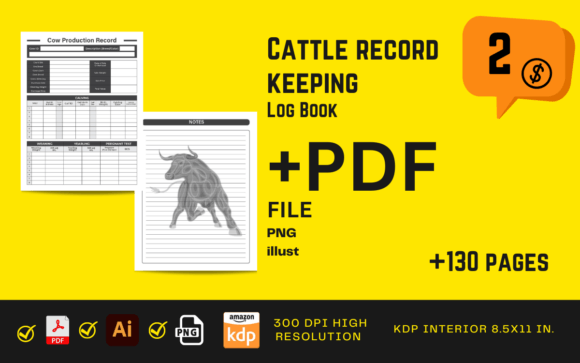
The Cattle Record Keeping Log Book: A Practical Tool for Better Herd Management
For anyone who manages cattle—whether a small-scale hobby farmer, a large commercial rancher, or a veterinary educator—the difference between a thriving operation and one that struggles often comes down to one thing: data. Without accurate records, decisions about breeding, nutrition, health, and culling are based on guesswork. The Cattle Record Keeping Log Book addresses this need directly. It is not just a notebook; it is a structured system designed to capture, organize, and retrieve the information that drives better outcomes. The specifications are practical: it measures 8.5 x 11 inches, contains 130 pages, and is available in PDF, JPG, and EPS formats without bleed. But more important than the dimensions is what those pages hold—a framework that supports both daily operations and long-term strategic planning.
Why a Dedicated Record Keeping System Matters
Cattle operations generate a staggering amount of information over time. A single cow can have multiple calving events, weaning weights, health treatments, and sale records. When that data is scattered across receipts, calendar notes, or memory, it becomes nearly impossible to spot patterns. For example, a producer might notice that calves from a particular sire consistently wean heavier, but without a formal record of that sire’s ID, breed, and the cow’s dam, the observation remains anecdotal. The Cattle Record Keeping Log Book provides a dedicated space for each of these data points, transforming scattered notes into actionable intelligence.
Beyond the individual animal, the log book helps with herd-wide analysis. Trends in calving intervals, weaning weights, or open rates after pregnancy testing can indicate broader health or management issues. A professional rancher might use this data to adjust breeding seasons, while a hobbyist could use it to decide whether to retain a heifer or sell. The log book bridges the gap between raw observation and informed decision-making.
Core Sections and How They Work Together
The log book is organized into several key sections, each serving a distinct purpose in the record keeping workflow.
Business Emergency Contacts List
At first glance, an emergency contacts page might seem unrelated to production records. But in practice, a veterinary emergency, a sudden feed shortage, or a transportation breakdown can halt operations. Having a dedicated page for veterinarians, feed suppliers, livestock haulers, and other critical contacts ensures that when a crisis hits, you are not scrambling for phone numbers. This is a small but essential feature that reflects the log book’s real-world orientation.
Cow Production History
This section is the backbone of individual animal tracking. For each cow, you record her ID, description, breed color, sire and dam information, birth date, weaning weight, purchase date, and purchase price. This history creates a permanent identity for every animal in the herd. For instance, if you buy a replacement heifer, noting her purchase price and date allows you to later calculate her lifetime return. The description and breed color fields help with visual identification, especially in herds where multiple animals look similar.
The inclusion of the cow’s sire and dam, along with their respective breeds, is particularly valuable for genetic planning. Over time, you can evaluate which bloodlines perform best under your management conditions. An educator might use this section to teach students about inheritance patterns, while a breeder uses it to select matings that improve carcass quality or maternal traits.
Date of Sale or Removal, Sale Weight, Sale Price, Total Value
Every animal leaves the herd eventually—whether through sale, culling, or death. Recording the date, weight, price per pound, and total value creates a complete financial picture. If a cow was purchased for $1,200 and later sold for $1,800, the gross return is clear. But when you combine this with her production records (number of calves, weaning weights), you can calculate her net contribution to the operation. This section turns the log book into a financial ledger as well as a biological one.
Individual Cow Production Record
This is where the detailed, event-level data lives. Each entry includes calving year, bull ID and breed, cow age at calving, calf ID, calf birth date, sex, birth weight, calving ease score, and calving interval in days. The calving ease field is critical: a cow with a history of difficult births may need to be culled or managed differently in subsequent pregnancies. Similarly, a consistently short calving interval indicates good reproductive health, while a long interval may signal fertility issues.
The calf ID field links each calf to its dam, creating a mother-offspring record that can be followed through the weaning and yearling sections. This cross-referencing is one of the log book’s strongest features. It allows you to track not just the cow, but her entire lineage.
Weaning: Weaning Weight and 205-Day Adjusted Weight
Weaning weight is a direct measure of maternal ability and calf growth. But raw weaning weight can be misleading if calves are weaned at different ages. The 205-day adjusted weight standardizes this, allowing fair comparison across calves born weeks apart. The Cattle Record Keeping Log Book provides space for both raw and adjusted weights, encouraging producers to calculate and record the adjusted figure. A 205-day weight of 600 pounds versus 500 pounds tells a story about genetics, nutrition, and management.
Yearling: Weaning Weight and 365-Day Adjusted Weight
Yearling weight reflects post-weaning growth and is a strong predictor of feedlot performance and eventual carcass weight. The 365-day adjusted weight again standardizes for age. Producers who sell yearling stock or retain ownership through the feedlot phase will find this section indispensable. A hobbyist with a small herd might use the yearling weight to decide which calves to keep as breeding replacements.
Pregnancy Test: Pregnant (P) or Open (O), and Body Condition Score (BCS)
Pregnancy confirmation is the final checkpoint in the reproductive cycle. Recording whether a cow is pregnant or open, along with her body condition score at the time of testing, provides immediate feedback on the breeding season’s success. A cow that is open two years in a row is a candidate for culling. A low BCS in a pregnant cow may require supplemental feeding to ensure a healthy calf and rebreeding. This section closes the loop: it tells you whether the previous year’s management decisions worked.
Practical Applications Across User Groups
The log book’s value extends across different audiences, each of whom will use it in slightly different ways.
Professionals and business owners need the log book for financial analysis, tax reporting, and genetic improvement. The purchase price, sale price, and total value fields feed directly into profit-and-loss calculations. The sire and dam records support planned matings. For a commercial rancher running 200 cows, the consistency of the format across all 130 pages makes data entry efficient.
Hobbyists and small-scale producers might have only a few cows, but the same principles apply. A family with two or three Jersey cows for home milk production can use the calving and weaning records to breed at optimal intervals. The emergency contacts list is especially reassuring for new owners who may not have a network of livestock professionals yet.
Educators and researchers can use the log book as a teaching tool. Veterinary or animal science students often learn best with real data. The structured fields force students to think about what information matters and why. A professor might assign students to create a mock production history using the log book format, then analyze the data to make management recommendations.
Creators and content developers in the agricultural space might use the log book as a template for digital tools or apps. The PDF, JPG, and EPS file options mean the log book can be customized, printed, or integrated into other materials. An extension agent could create a binder of log books for a producer training course.
Ease of Use and Practical Considerations
At 8.5 x 11 inches, the log book is standard letter size, fitting easily into a binder or file cabinet. The 130-page count provides ample space without being unwieldy. The no-bleed format keeps margins clean, which is useful if you scan pages for digital backup. The availability of PDF, JPG, and EPS files means you can print as many copies as needed, fill them out digitally, or use the EPS file to design custom covers or dividers.
One practical workflow: keep the log book in a waterproof pouch in the barn or truck. After each calving or weaning event, record the data immediately. At the end of the month, transfer key summary figures to a spreadsheet for trend analysis. The log book becomes the primary source document, while the spreadsheet handles aggregate calculations. This separation of roles—capture versus analysis—keeps both tasks manageable.
Observations on Long-Term Use
Over several seasons, the Cattle Record Keeping Log Book reveals patterns that are invisible in the moment. For example, you might notice that cows with a higher birth weight tend to have lower calving ease scores. Or that certain sire lines consistently produce calves with above-average 205-day weights. These observations become the basis for better breeding decisions.
Another observation: producers who use the log book consistently tend to identify problem animals earlier. A cow with a declining body condition score over two consecutive pregnancy checks can be evaluated before she becomes a chronic issue. In contrast, relying on memory often leads to delayed action.
The log book also supports continuity. If a farm changes hands or a manager leaves, the records remain. New owners or employees can review the history of each animal and the herd as a whole, accelerating their learning curve. This is especially valuable in educational settings where students rotate through a teaching herd.
Integrating the Log Book into a Broader Management System
No single tool can cover every aspect of cattle management. Health treatments, vaccination schedules, and feed rations are typically tracked separately. But the log book focuses on production and reproduction—the metrics that directly affect profitability and genetic progress. By maintaining these records diligently, you create a foundation that can be paired with other tools. For instance, health records from a veterinary app can be cross-referenced with the calving and weaning data in the log book to identify correlations between disease events and production dips.
The file formats also allow integration with digital workflows. If you prefer to type rather than handwrite, the PDF can be filled on a tablet. The EPS file can be opened in vector editing software to modify the layout for specialized needs. This flexibility makes the log book suitable for both analog and digital environments.
Why This Approach Works
The Cattle Record Keeping Log Book succeeds because it is not overly complex. It captures the essential data points without demanding unnecessary detail. The fields are chosen to support the most common decisions in cattle production: which animals to keep, which to breed, which to sell, and when. The layout follows the chronological flow of a cow’s life—from birth through weaning, yearling stage, and pregnancy testing—making it intuitive to use.
For a broad audience, from professionals to hobbyists, the log book offers a balance of structure and flexibility. It does not prescribe a specific management philosophy; it simply provides a place to record the facts. What you do with those facts is up to you. That is the essence of good record keeping: it empowers better decisions without dictating them.
In a world where data is increasingly valued, the log book stands as a practical, field-tested tool. Whether you are managing a herd of fifty or five, the discipline of writing down the details creates clarity. And clarity, in cattle management, translates to healthier animals, more efficient operations, and ultimately, better results.