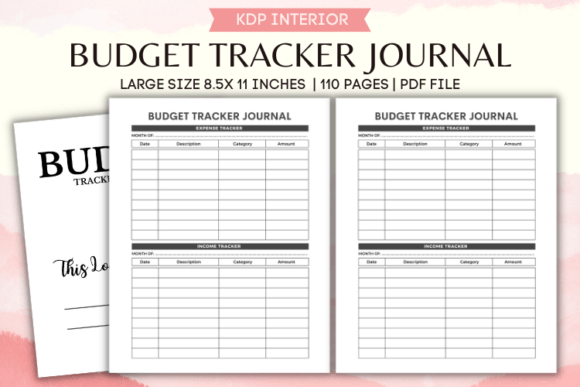
Budget Tracker Journal: A Practical Framework for Financial Clarity
Managing personal finances often feels like navigating a ship without a compass. You earn, you spend, and at the end of the month, you wonder where the money went. A Budget Tracker Journal bridges that gap between intention and awareness. It is not merely a ledger; it is a structured space where income, expenses, and savings are recorded with purpose. When you use a dedicated journal, you shift from reactive spending to proactive stewardship of your resources.
Why a Physical Tracking Tool Still Matters in a Digital Age
Digital apps and spreadsheets offer convenience, but they also introduce friction. Notifications, logins, and sync issues can interrupt the habit of recording. A Budget Tracker Journal in a large 8.5x11 inch format provides an uninterrupted canvas. The generous size reduces eye strain and allows you to see entire weeks or months at a glance. Writing by hand also activates cognitive processes that typing does not. When you physically write an expense, you are more likely to remember it and reconsider similar future purchases. This tactile engagement transforms tracking from a chore into a reflective practice.
Moreover, the downloadable PDF format gives you flexibility. You can print the journal at home, use a local print shop, or upload it directly to Amazon KDP for publishing. This adaptability means you are not locked into any single workflow. Whether you prefer a spiral-bound notebook or a professional paperback, the journal adapts to your preferred medium.
Understanding the 110-Page Structure as a Financial Cycle
A common challenge with financial tracking is maintaining consistency over time. The Budget Tracker Journal spans 110 pages, which is sufficient for approximately three to four months of detailed tracking, depending on how many categories you monitor. This duration aligns well with quarterly reviews. It gives you enough data to identify patterns without becoming overwhelming. After one cycle, you can assess what works, adjust your categories, and begin a new journal with refined goals.
The layout typically includes sections for income, expenses, and savings. Each category is given enough space to capture line items without clutter. You can note not just the amount, but also the context of a transaction. For example, a grocery expense might include a note about meal planning or an impulse buy. This contextual data becomes valuable when you later review your spending habits.
Income Tracking Beyond the Paycheck
Many people track only their primary salary, but modern income streams are often diverse. Freelance work, side gigs, passive income from investments, rental properties, or even cash gifts all affect your financial picture. A well-designed budget tracker allows you to list multiple income sources separately. This separation helps you see which streams are growing and which are stagnant. Over time, you can make informed decisions about where to invest your energy.
For professionals with irregular income, such as consultants or gig workers, tracking every incoming payment is essential for tax preparation and cash flow management. The journal's consistent format simplifies this process. You do not need to adapt to a new spreadsheet each month. You follow the same rhythm, which builds the habit.
Expense Categorization as a Mirror of Priorities
Expenses reveal what you truly value, sometimes in ways that surprise you. When you record each outflow in a Budget Tracker Journal, you create a mirror of your priorities. Fixed expenses like rent or utilities are predictable, but variable expenses like dining out, entertainment, or subscriptions often accumulate quietly. By writing them down, you gain visibility into areas where adjustments are possible.
Consider a professional who discovers that coffee shop visits account for more than their monthly internet bill. That observation alone can prompt a small behavioral shift. The journal does not dictate what you should spend; it simply presents the data. You retain control over your choices, now informed by accurate records rather than guesswork.
Savings Tracking as a Motivational Anchor
Saving money is often cited as a goal, but without tracking, it remains abstract. A dedicated savings section within the journal transforms saving from an afterthought into a measurable activity. You can set a monthly savings target and record your progress alongside your expenses. This side-by-side comparison reinforces the relationship between spending less and saving more.
For families or couples, a shared journal can serve as a neutral tool for financial discussions. Instead of arguing about who spends too much, both parties can review the recorded data together. The journal becomes a reference point for joint decisions, such as whether to reduce a certain category or increase savings contributions.
Goal Setting and Progress Monitoring
One of the most powerful features of the Budget Tracker Journal is the dedicated space for goals. Financial goals vary widely: building an emergency fund, paying off debt, saving for a down payment, funding a vacation, or investing in education. Writing a goal down increases commitment. When you also track progress weekly or monthly, you maintain momentum.
The journal's 110 pages allow you to set multiple goals and revisit them over time. You can note the target amount, the deadline, and the current balance. This structure turns a vague aspiration into a concrete project. For example, a small business owner might set a goal to save for new equipment. Each journal entry shows how small, consistent contributions add up. The visual progress is itself a reward.
Use Cases Across Different Audiences
The Budget Tracker Journal is not limited to one type of user. Its flexibility makes it suitable for a broad range of situations.
- Professionals can use it to track business expenses separate from personal spending, which simplifies tax reporting and reimbursement requests.
- Freelancers and gig workers benefit from tracking irregular income and variable expenses, helping them smooth out cash flow fluctuations.
- Students can build financial literacy early, learning to manage a limited budget while balancing part-time work and studies.
- Families can use a single journal to track household expenses, teach children about money, and align on shared financial goals.
- Retirees on fixed incomes can monitor spending against their pension or Social Security, ensuring they do not overspend.
- Small business owners can track startup costs, operational expenses, and revenue streams in one portable place before moving to formal accounting software.
Each user type adapts the journal's categories to their own context. The open-ended structure does not impose rigid labels. You decide what fits your life.
Practical Workflow: From Recording to Reviewing
Getting the most out of a Budget Tracker Journal involves a simple but consistent workflow. First, set aside five to ten minutes each day to record transactions. This habit prevents the buildup of unrecorded expenses. Second, review your entries weekly. Look for trends, unexpected spikes, or categories that need adjustment. Third, set aside a longer session at the end of each month to compare your actual spending against your budgeted amounts.
The large 8.5x11 inch size makes these reviews easier because you can see multiple entries without flipping pages constantly. The spacious layout also accommodates handwritten notes, calculations, and corrections. If you prefer digital storage, you can scan or photograph the pages for backup. The PDF format ensures you can always print a fresh copy if you make a mistake or want to start a new tracking period.
Overcoming Common Tracking Pitfalls
Many people abandon financial tracking because they aim for perfection. They miss a day and feel the entire record is compromised. The journal format forgives gaps. You can backfill entries from receipts or bank statements. The goal is consistency over time, not flawless daily logging. Even if you record expenses only three or four times per week, you will still have valuable data.
Another common pitfall is underestimating small expenses. A coffee here, a snack there, a subscription that auto-renews. These micro-expenses often add up to significant amounts. The journal's granular tracking captures them. Over a 110-page cycle, you might be surprised to see how much these small items represent.
Considerations for Creators and Educators
For content creators, educators, and workshop facilitators, the Budget Tracker Journal can be a teaching tool. You can use it in financial literacy courses, coaching sessions, or as a handout in community workshops. The downloadable PDF format means you can distribute it digitally or print copies for participants. Its neutral design does not assume prior knowledge, making it accessible to beginners.
Educators can integrate the journal into a curriculum on personal finance, entrepreneurship, or life skills. Students learn by doing. They practice recording transactions, setting goals, and reviewing outcomes. This hands-on experience is more durable than reading about budgeting in a textbook. Researchers studying financial behavior can also use the journal as a structured data collection instrument, asking participants to record spending over a defined period.
Adapting to Different Financial Philosophies
There is no single "correct" way to budget. Some people prefer the envelope system, others use zero-based budgeting, and still others follow the 50/30/20 rule. The Budget Tracker Journal supports any of these approaches because it does not prescribe a specific method. You decide how to categorize your income and expenses. The journal provides the structure; you provide the rules.
For example, if you follow the 50/30/20 rule, you can label your categories accordingly: needs, wants, and savings. If you use the envelope system, you can track cash withdrawals and their allocation. The flexibility is intentional. A rigid tool often fails because it does not match a person's reality. This journal adapts to yours.
Long-Term Value of Repeated Use
One journal cycle of 110 pages provides a snapshot. Using the journal repeatedly over multiple cycles creates a longitudinal record. You can compare your spending patterns across seasons, years, and life changes. Did your expenses increase after a promotion? Did your savings accelerate after paying off a loan? These comparisons become possible only if you have consistent records.
The large format also allows you to keep previous journals as reference. They take up minimal physical space and can be revisited anytime. This archive becomes a personal financial history that you can analyze for trends, plan for future goals, or simply appreciate how far you have come.
Practical Tips for Getting Started
If you are new to using a budget tracker, start with the essentials. Identify your main income sources and your top five expense categories. Do not try to track every single line item from day one. Gradually expand as you become comfortable. Use the goal-setting pages to define one clear financial objective for the first month. It could be as simple as "spend 10% less on dining out" or "save $50 this month." Achieving a small goal builds confidence.
Keep the journal in a visible location, such as on your desk or kitchen counter. Out of sight often leads to out of mind. The 8.5x11 inch size is prominent enough to serve as a visual reminder. Pair your tracking habit with an existing routine, such as morning coffee or evening wind-down. Consistency is more important than duration.
For those publishing on Amazon KDP, the ready-to-upload PDF format saves design time. You can focus on content and layout tweaks rather than building from scratch. The large trim size is popular among KDP buyers because it feels substantial and easy to write in. Consider adding a brief instruction page at the front to help users get started immediately.
Ultimately, a Budget Tracker Journal is a tool for empowerment. It does not judge your spending; it illuminates it. The 110 pages represent 110 opportunities to align your actions with your values. Whether you are a professional managing a household, a student learning financial basics, or an educator guiding others, this journal provides a clear, adaptable framework for taking control of your finances one entry at a time.